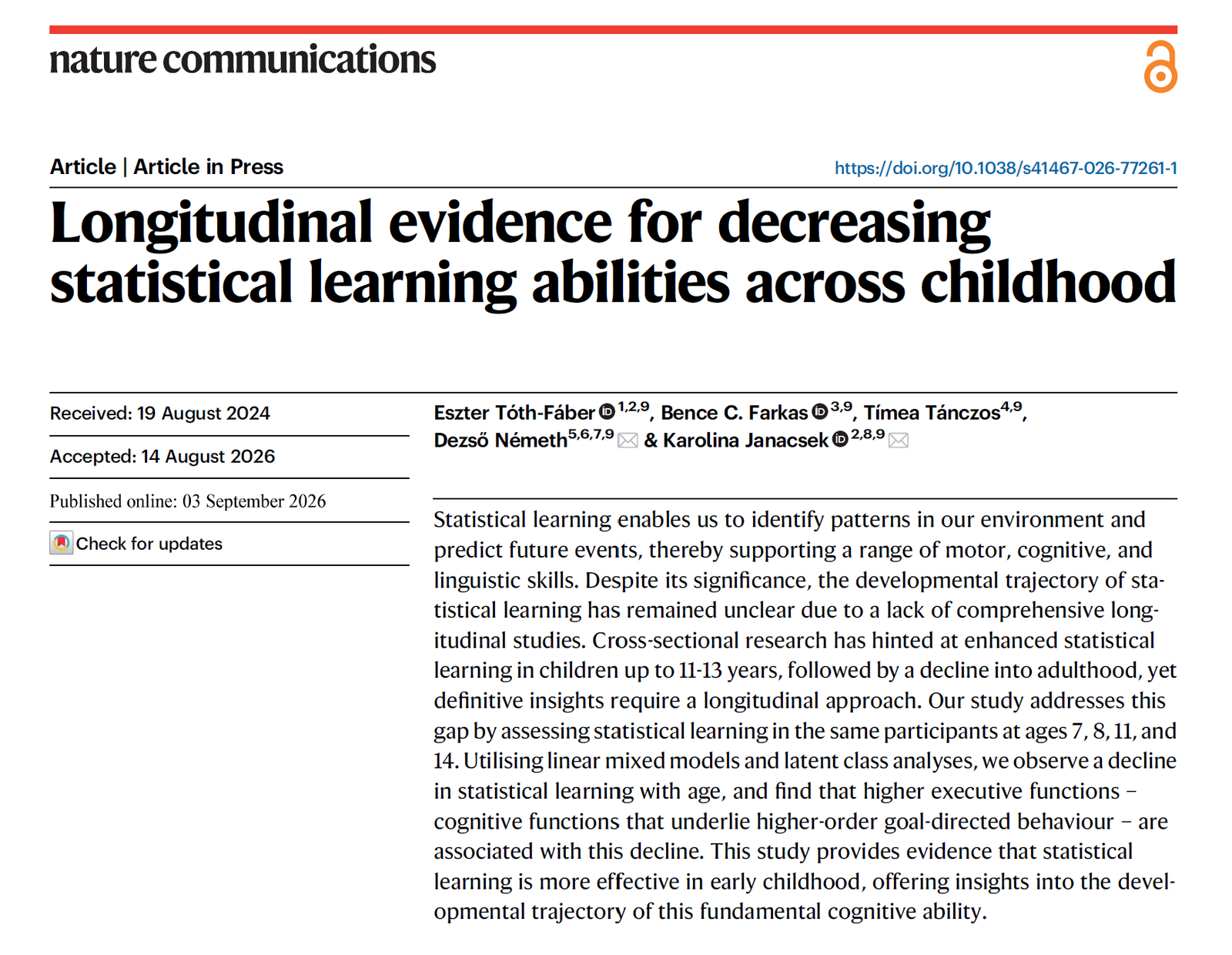
We are thrilled to share that our team has published a new paper in Nature Communications titled “Longitudinal evidence for decreasing statistical learning abilities across childhood”.
How does our ability to pick up regularities from the environment change as we grow up?
Our latest longitudinal study tracked children across seven years, at ages 7, 8, 11, and 14, to map the developmental trajectory of statistical learning. The findings demonstrate that implicit statistical learning abilities gradually decline across childhood, and that this shift is closely linked to the maturation of executive functions. As top-down cognitive control strengthens, the brain moves from picking up raw environmental statistics toward relying more on internal models and prior knowledge.
These results provide crucial longitudinal evidence that statistical learning is most potent in early childhood, shedding new light on why young children are uniquely suited for acquiring foundational skills and language.
Congratulations to the team!
A huge congratulations to the authors: Eszter Tóth-Fáber, Bence C. Farkas, Tímea Tánczos, Dezső Németh, and Karolina Janacsek!
Publication details
Tóth-Fáber, E., Farkas, B. C., Tánczos, T., Németh, D., & Janacsek, K. (2026). Longitudinal evidence for decreasing statistical learning abilities across childhood. Nature Communications. https://doi.org/10.1038/s41467-026-77261-1
Read the full paper here: https://www.nature.com/articles/s41467-026-77261-1